Global Imbalance - An Imminent Dollar Crisis
Thursday, October 16, 2008

Sunday, June 29, 2008
8 Technologies for a Green Future
8 Technologies for a Green Future
Today's breakthroughs are a good start, but the best is yet to come. From at-home hydrogen fueling stations to toxic-waste-eating trees, a look at the most promising solutions of tomorrow.(Business 2.0 Magazine) -- The planet's most pressing environmental problems - global warming, energy shortages, over fishing, pollution - may seem just too big to be solved with today's technology. But don't despair: A lot of bright minds are working on futuristic projects that promise to make the world greener while making entrepreneurs some green.
It's save-the-world stuff like toxic-waste-eating trees, smart electricity grids, oceangoing robots, and floating environmental sensors. Then there's the alternative-energy home fueling station that could jump-start the long-awaited hydrogen economy. This technology may seem far out - but it will probably be here a lot sooner than you think.
1. Home hydrogen fueling station
What could be cooler - or greener - than a hydrogen car in your driveway? Try a solar-powered hydrogen fueling station in your garage. Scientists in Melbourne, Australia, have developed a prototype of such a device. It's about the size of a filing cabinet and runs on electricity generated by standard-issue rooftop solar panels.
The first version of the home fueling station is expected to produce enough hydrogen to give your runabout a range of some 100 miles without emitting a molecule of planet-warming greenhouse gas. Road trips are out of 
"You don't need a hydrogen infrastructure to introduce the hydrogen economy," says Sukhvinder Badwal, a veteran fuel-cell scientist leading the project at Australia's Commonwealth Scientific and Industrial Research Organisation.
The solar-fired fuel-station-in-a-box leapfrogs two big obstacles to the much-hyped hydrogen economy. One is the multibillion-dollar expense of building national networks of pipelines and fuel stations to replace the corner Chevron.
The other is the fact that today most hydrogen is produced by burning fossil fuel to create hydrogen gas - not exactly a clean and green process. The home hydrogen fuel station solves those problems in one package that Badwal hopes will ultimately sell for about $500.
The heart of the fuel station is an electrolyzer - essentially a fuel cell run in reverse. An electric current from solar panels (a home wind turbine would also do the job) separates water into hydrogen and oxygen. The hydrogen is compressed and stored, ready for use in a fuel-cell car or an electric/hydrogen hybrid with an engine converted to run on the gas.
CSIRO is in talks with potential commercial partners, so Badwal's lab is off-limits to visitors. But on his computer screen, he reveals a box that would fit easily in the corner of a garage next to the mountain bikes.
Real-world tests of the home fueling system were to begin early this year at RMIT University in Melbourne, with commercial trials two years off. Obstacles remain, including the cost of hydrogen cars, but the technology could go a long way to making the family wagon carbon-neutral. (Read more about home hydrogen fueling stations on the Green Wombat Blog).
2. Environmental sensor networks
Call it the networked environment. Picture tiny - we're talking small as a dime - wireless sensors lining lake beds and ocean floors, buried in the ground, and floating in the air. All the time sniffing the air, water, and soil for chemicals and pollutants and detecting changes in temperature and pressure. 
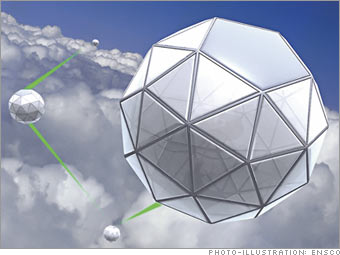
The payoff: real-time data on a variety of phenomena that affect the economy and society - climate change, hurricanes, air and water pollution. Scientists are capitalizing on advances in wireless tech and nanotechnology to build networks of these environmental sensors.
Arizona State University scientist Joe Wang has already deployed them in San Diego Bay and the canals of Venice to keep watch on heavy-metal levels and mercury contamination. Researchers at the University of British Columbia and the University of California at Berkeley, meanwhile, have created a coin-size solar cell that could power the transmitters for sensor networks that one day might monitor a river or a bay for leaking pipelines.
Cooler yet are solar-powered sensors that hover in the air. Ensco, a technology company based in Falls Church, Va., is developing a beach-ball-size gadget that gets its juice from thin-film solar panels and would measure weather patterns by probing the curve of a jet stream or the interior of a hurricane.
3. Toxin-eating trees
Plant a forest, clean up a Superfund site. That's the idea behind phytoremediation, a technology that uses vegetation to absorb hazardous waste from industrial plants and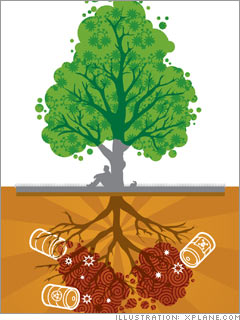
The technique has been around for years but hasn't proven very effective. Now there's a new twist that promises to make toxic dumping grounds green in more ways than one.
Researchers at York University in Britain have identified bacteria living in the roots of poplar trees that produce an enzyme that zaps residue from RDX, a chemical compound used by the military and industry. The scientists are working on ways to genetically engineer the enzyme to boost the tree's ability to suck up toxic waste. So don't be surprised if you start seeing forests sprouting on old military bases.
Meanwhile, a team from the University of Georgia has transplanted a gene from bacteria that helps neutralize mercury contamination into a common flower. The result: a solar-powered bioremediation system that smells nice too.
4. Nuclear waste neutralizer
Forget Three Mile Island, Chernobyl, and Homer Simpson. Nuclear energy is making a comeback, and it's now being touted as a greenhouse-gas-free solution to global warming. But one big problem remains: What to do with untold tons of radioactive waste that will be red-hot for hundreds of thousands of years?
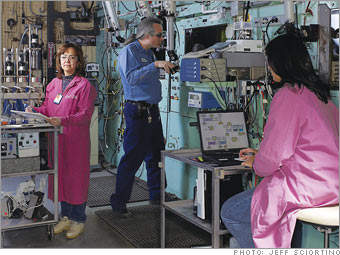
The answer: Recycle it. But not with current nuclear-waste-reprocessing technology, which leaves behind an unfortunate by-product - weapons-grade plutonium. Instead, scientists at the government's Argonne National Lab near Chicago are devising a chemical technology called Urex+ that extracts reusable uranium and separates out cesium, allowing four times as much waste to be packed into nuclear burial grounds.
Such technology would at last make a nuke-plant-building boom ecologically feasible, but that's far from the only benefit. It would also leave the plutonium encased in other elements, rendering it all but useless to terrorists, North Korean dictators, and other evildoers. In addition, plans are afoot for a new type of nuclear reactor that could burn the reprocessed waste as fuel. But the inevitable fight over a nuclear revival is some time off - it'll be five to 10 years before the waste-reprocessing technologies are ready for prime time.
5. Autonomous ocean robots
The world's seas are in an ocean of trouble: climate change, vanishing fish, coral bleaching. Just keeping tabs on an airless environment that covers three-quarters of the earth's surface is a bit like exploring a distant planet. Which means it's best to send in the robots.
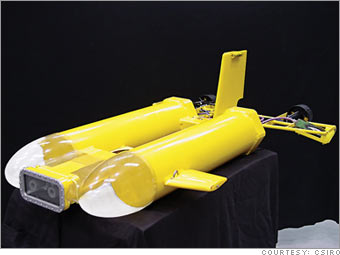
Unfortunately, today most oceangoing bots are big, dumb, and expensive. They need to be tethered to boats and operated by humans who collect paychecks. But not the Starbug. Under development in Australia, the 4-foot-long yellow robot operates autonomously and is highly maneuverable, thanks to its innovative thruster technology and robotic vision.
According to the robot's designer, scientist Matthew Dunbabin of CSIRO, the Starbug will monitor water quality, map fish habitats, and survey threatened coral reefs. It could also be deployed to detect drops in fish populations, as well as being dispatched to help with underwater gas and oil exploration.
Rather than relying on costly sonar, the Starbug "sees" its surroundings. Its cameras and the onboard Linux operating system let the robot identify and count, for instance, marine pests that are killing off parts of the Great Barrier Reef, a 135,000-square-mile ecological cash cow that generates $8.3 billion annually in tourism revenue.
With the robot's initial cost at an estimated $24,000, Dunbabin envisions fleets of Starbugs launched from shore or small boats. His team is now building the next-generation Starbug, which should start rolling off the assembly line late this year.
6. Sonic water purifier
Here's a sci-fi solution for an age-old problem that leaves 1.1 billion people without access to clean water: Beam ultrasound waves into polluted water, blowing up the cellular walls and carbon bonds of contaminants. What's left is a cool drink of fresh H2O.
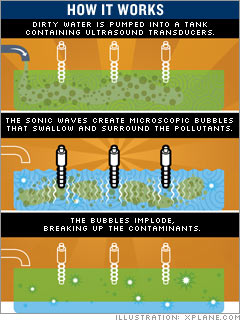
Filters and chemicals are normally used to purify dirty water, but researchers are experimenting with ultrasound technology as a cheaper alternative. Ultrasound waves have already been used to break up sewage in sanitation systems.
Now that the probes that produce the sound waves are getting more powerful, however, scientists are retooling the devices to decontaminate large tanks of water, a process called sonolysis.
The goal is twofold. First, portable sonolysis machines could be deployed to isolated villages in developing countries. In urban areas, meanwhile, sonolysis could treat water tainted with industrial pollution. Scientists like Villanova University's Rominder Suri are studying how sound waves can break down chemicals into less harmful components, detoxifying wastewater.
7. Endangered-species tracker
Old: Save the whales! New: Web 2.0 those whales, and then clone 'em! There are more than 16,000 known threatened animal and plant species; their plights worsen each year as deforestation, development, and climate change take their toll.

Conservationists are looking to tag endangered animals like the Amazon's piglike white-lipped peccary with radio frequency ID tags and GPS sensors, and then use Web 2.0 mashup techniques to overlay their locations and map details of their habitats and habits with other landscape features. The plan is to identify and design better wildlife preserves to ensure the survival of species edging toward extinction.
For animals on the brink of oblivion, brave-new-world steps are being contemplated. In 2003, scientists cloned an endangered banteng cow, and XY Inc. of Fort Collins, Colo., has developed sperm-sorting technology that could one day be used for sex selection in endangered species to boost captive breeding programs. India, meanwhile, is setting up a laboratory to cryopreserve the sperm and DNA of rare Bengal tigers and other animals so they can eventually be cloned.
8. The interactive, renewable smart power grid
California utility Pacific Gas & Electric (Charts) is developing the electricity grid of the future, one that will look more like the Internet - distributed, interactive, open-source - than the dumb, one-way network of today that pushes dinosaur molecules from a carbon-spewing power plant to your home.
Hal LaFlash, PG&E's director of renewable-energy policy and planning, gave Business 2.0 a preview of the technologies and energy sources that utilities will tap for the power grid of tomorrow.
Solar stations Large-scale plants using new thermal and photovoltaic technologies will operate in Southern California and the desert Southwest.
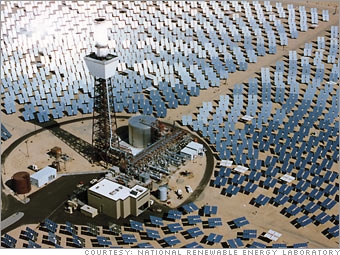
Solar buildings As solar cells are integrated into rooftops, walls, and windows, homes and office towers will become miniature power stations, generating their own electricity and feeding excess power back into the grid.
Wind power Anywhere the wind blows is a potential site for a turbine, but the Great Plains is the place utilities are eyeing for giant wind farms.
Wave power PG&E is looking at the Northern California coast for potential sites for wave energy generators. The Northeast coast is another prime source of as-yet-untapped wave power.
Cow power California has 1.7 million cows and more than 2,000 dairies. A dozen dairies have already installed methane digesters to turn cow manure - a source of one of the most destructive greenhouse gases - into electricity. The digester extracts methane gas from cow poop and uses it to power an electricity-generating turbine. Other dairies have plans to produce a bovine biogas that will be piped to power plants.
Car power PG&E is developing technology that will allow future "plug-in" hybrid vehicles not only to recharge their batteries but also to feed electricity back into the power grid during peak demand.
Clean-coal plants Located mainly in the East and Midwest, these plants will gasify coal, stripping it of pollutants. Carbon dioxide will be captured before it can be released into the atmosphere.
Smart grids Interactive power grids will communicate with smart agents embedded in household appliances, allowing power to be distributed where it is needed most.
Monday, March 10, 2008
Why aren't there many software product startups in India ?
Why There Aren’t More Software Startups In India
Some factors that govern the lack of software startups culture prevalent in india could be one or all of the following:
Some factors that govern the lack of software startups culture prevalent in india could be one or all of the following:
- Service Companies Have Lower Risk: Unlike product companies that usually require some R&D and investment before revenues and cash-flows can kick in, service companies can (and often are) profitable very quickly. The business model for a software services company (commonly an outsourced development company) is fundamentally simple. Hire labor from the large pool of local talent at a price that is market competitive for
- Lack Of Significant Precedence: One of the great things about the startup community here in the
- Early-Stage Capital Is Even Harder Than In The
- Recruiting Great Employees Is Challenging: Lets assume for a minute that you are a software entrepreneur in
- Too Much Bureaucracy: In the
- Product Companies Are Hard: At the risk of drawing stereotypes, I think Indians in general are a little impatient and like to see quicker “payback” periods on their investments. There are a few number of them (than in the U.S.) that are willing to spend the 2+ years it might take to build a product, see how the market responds and “tweak” the business as necessary to get it to a successful state. Product companies are also more “random” and difficult to control the outcome of. They involve a large number of “creative” factors that will largely influence whether the product succeeds or not. I’ve found Indians to be almost overly practical (in the short-term sense) and not passionate about some of the softer things (like user experience, marketing, branding and other things) which in today’s world are large contributors to future outcomes of software startups. They’d much rather work on the “harder” stuff that they can better control and predict. This is a bit of a “squishy” argument, but it’s a squishy issue. I guess the evidence of progress I’d like to see is a cool software product coming out of an Indian startup along the lines of an Adobe Photoshop or even a 37signals Basecamp or meebo.
Wednesday, March 5, 2008
Services companies practically cannot become Product Companies !!!
Why Infosys can’t be a product making company?
Before I answer this question (not that I have this beautiful and simple answer which suddenly solves the problem), let me talk about how we got here. Infosys is a great company. I admire Narayana Murthy for what he has done. He is like a WWI War Hero. He fought the war in trenches, faced the gas bombs and artillery shells. He created a services company and made an empire out of it. The fallout of building such an empire has been great for many other companies as well. MNCs started to look at
In addition to Infosys, there are other great services companies, like, Satyam, HCL, Wipro, TCS, etc. The combined intake of engineers by these companies is pretty high. Some of these companies take 60-80 engineers from a single college. In the whole process, they create many engineers who are good at delivering services. Services companies have only two factors to play with- Utilization factor and Average Salary. The mantra is- “Keep most of your assets (employees, labs, and other resources) billable and keep the average salary of the employees to minimum”. Give this as a problem to any lay man and he will come up with almost similar strategy most of these services companies employ. You want your engineers to be on a project all the time. So, you scout for projects in all domains and put your engineers to work on them. Though a certain level of skill/expertise is required, you also figure out that most engineers can take up almost any project and work on it. You create engineers who are jack-of-all-trades. Then you also have a set of excellent managers who manage the gargantuan task of delivery (in time and with quality) using these jack-of-all-trades engineers. To keep the Average Salary low, one has to continuously recruit fresh engineers and move the experienced people out or to a management role. So don’t be surprised to see five-year experienced engineers becoming project leaders, and seven-year experienced engineers becoming project managers. Over a period of time, what you get out of such companies are excellent managers; managers who are proficient in delivery mechanism, who know how to thrive and deliver in a services environment, where the parameters for success are very different from that of a product making company. Those who do not succeed in such an environment will be weeded out slowly; or they force themselves to fit into such environments by working on their weaknesses and strengths to adapt to such environment. Give this process twenty years and what you have is hundreds of managers and leaders who are good at running services companies. This is like creating many Generals and Soldiers suitable for WWI. (Just for the sake of argument) Imagine WWI to be services industry while WWII is a product making company.
Now, how can these leaders be suitable for product-making industry (WWII)?
Just by infusing cash and incentives you can’t make product making companies out of this environment. To wage a new kind of war these Generals and Soldiers have to consciously adapt to new rules. Yes, they have the ability to adapt but will they do it? Why should they do it? Especially after winning the laurels and successes in WWI they are keen on keeping the warfare more WWI-like and reap rewards. It is not in their interest to change the rules of the game. Why should one change the rules of the game and turn out to be a loser?
Therefore, all the success stories we get to see are come from services industry. The ex-entrepreneurs are all from services companies and they tend to promote more services company. Books are written on how
If there are any product-making companies out there, they are exceptions. Such startups may find it difficult to get senior team members with product-making experience. Most of the potential team members with 8-12 years of experience are now managers in a services company. Are they valuable to a product-making startup? Even if they are, will they leave their cushy job and lifestyle to take on this new kind of warfare which they are not used to? Moreover, the startups in product-making space will not find advisors who are veterans of this industry. The VCs are not ready to fund such high risk companies who do not have enough exposure to this different game. Why should they when they have a choice to start another services company? Therefore, most product-making ideas do not take off.
You need precedents to create such an environment but how can you create such environment when you can’t even start off? That’s where it becomes very tough for someone to startup a product-making company in
Another analogy that I use is that of a space probe (like Voyager) launched into space. You have two choices. You can move to a planet like Jupiter and use its gravitational force to become a satellite of Jupiter and stay there forever, or use the same gravitational force plus an added thrust to move to the next planet. Most of the Indian companies tend to choose to stay at one level, that is services company, and do not want to venture further to the next level, that is product-making company.
Why do I stress so much on product-making companies?
It’s simple actually. [To repeat myself] In short, it [services-company] is not a scaleable business. If a services-company does $2 Billion revenues with (say) 50,000 engineers, to get to $20 Billion in revenue they need to hire 500,000 engineers. It’s not very practical.
Compare this with a product-making company. A small group of individuals can make a big difference and if successful can create mega business. And it’s not hard to think of a 50,000 people product-making company with $50 Billion revenues.
[Note that I took Infosys just as an example. I could replace it with any other services company and this topic still holds good]
Friday, February 22, 2008
THE GREATNESS OF THE VEDAS
THE GREATNESS OF THE VEDAS
by
JEFFREY ARMSTRONG
JEFFREY ARMSTRONG
Thirty years ago, when I began my spiritual journey, I was studying English literature, and if you study English literature you will be taught that English and all of the romance languages of Europe can be traced back to the Latin, and then from the Latin back to the Greek. Modern Western history teaches us that the trail mysteriously stops at that point in time, although it is a well-known fact that the ancient Greeks sat at the feet of the Egyptians and the Babylonians. So when India was discovered by the West a few centuries ago there was a clash of cultures over the origins of human civilisation. The West held a viewpoint of time that ended with the Greeks whereas the East, and India in particular, spoke of a time span of well over fifty thousand years. The Western vision simply could not accommodate this understanding. So they made up a story to explain away this anomaly. When people from the West colonised India and began to study the Indian culture, they established a chair of Sanskrit at Oxford University called the Boden chair. The main function of the Boden chair of Sanskrit was to translate the Bible into Sanskrit. The people who studied Sanskrit then went to India and occupied various ministerial posts within the British Government, and they began to study the Vedas. As they began studying, they discovered that Sanskrit was the mother language for both Greek and for Latin, and in fact, for all the romance languages of Europe. This discovery gave rise to the modern science of Linguistics. The classification of modern languages was only made possible by an understanding of Sanskrit.
This revelation caused a problem because at that time India was a colony of the British. As one of my professors used to say, "You refer to India as the sub-continent, but could you tell me exactly what it is sub too?" Of course, the saying was intended to imply subordinate to Her Majesty the Queen. It was a bit of an embarrassment to run into a culture that not only claimed that its history went back fifty or sixty thousand years, but that it was also the basis for your own language and literature! The British couldn't accept this and so the scholars of the time made up a theory, which said that there was a group of people called the Aryans, who lived in the Steppes of Russia, and this horseback riding people rode into India one thousand five hundred years ago with these books called the Vedas under their arms. Unfortunately, what they did not take into account was the fact that the Vedas contained astronomical calculations that went back seven thousand years! Now there is no instance or evidence of a horseback riding culture having observatories who watched the stars over a period of seven thousand years. Nevertheless, Western scholars overlooked this inconsistency and believed the theory that the Aryans came riding into India and conquered the dark skinned Dravidians with their superior technology and their superior wisdom.
This theory was very similar to the one put forward by Adolph Hitler in his promotion of the Aryan Race. He took this great term Aryan from the Vedic culture, a term which literally means noble people who are trying to liberate their soul from the darkness of matter. It has nothing to do with race, has nothing to do with culture, but it has everything to do with spiritual aspiration, with the liberation of the atma from tamas or darkness. Hitler took this word because he believed that Aryans were the people who had invaded India from the North and he thought that his ancestors came from them. No one has honoured the fact, until very recently anyway, that Sanskrit is the language from which all the other languages of the world evolved.
Some very exciting things have been happening in recent years. You probably know that the Vedas refer to three sacred rivers in India, the Jamuna, the Ganga and the Saraswati, but if you go to India today, you will find no Saraswati River. There is only the Jamuna and the Ganga. Therefore, some scholars have argued that the Vedas were just legends, stories made up by Indians to prove that their culture was indeed fifty thousand years old. However, quite recently, satellite photography has provided evidence of the dried up bed of the Saraswati, meandering just like a river, many miles away from the Ganga. Thus, modern technology has proved what the scholars of India have always proclaimed, that there was a river but that it had dried up. Indian history relates that there was a thriving culture all along the Saraswati River but that culture migrated over to the Ganga River when the river dried up sometime between 10,000 and 7,000 B.C.
So with the discovery of the Saraswati River whole groups of archaeological facts have now begun to fall into place. Archaeologists are re-examining the sites of the ancient cities of India and it is now generally accepted that there was no Aryan invasion of India. The Aryans did not come from the foot hills of Russia simply because they were already in India. The evidence clearly shows that this Indian culture existed over fifteen thousand years ago and that it was from this group of people that the great culture of the country of Bharat, now known as India, came.
The Mahabharata, the great Sanskrit epic of ancient India, records the history of Bharat and the Bhagavad-Gita. It contains within it, the events of five thousand years ago when Lord Krishna appeared and spoke to Arjuna on the battlefield of Kurukshetra, which saw the triumph of the Pandavas over the Kauravas, the triumph of good over evil. That event marked the beginning of Kali Yuga. So the Sanskrit of the Vedas refers to an era before that time and to the existence of a pool of knowledge that has survived for thousands of years. That is why India and Indian culture is the mother of all modern civilisations.
You could say that our greatest enemy is forgetfulness, because history, which is nearly always a subjective viewpoint, erases memory and the true story gets lost. In India, however, scholars have been trying to maintain the story of ancient Bharat because this story, this history, is in fact the story of God coming down to Earth. That is what is so significant about the history of Bharat. It is an actual record, a recollection of God coming down to Earth and of His teaching, His Life and the display of His powers.
The Vedic scholars understood that it is difficult for us to learn things in this physical world. For example, we are all trapped in this room right now and we don't know what's going on outside. This is a similar situation to us living in the physical world. We live in the physical world but our physical senses cannot see outside of it. There are three ways of learning, of getting knowledge. Firstly, we learn through our senses, we experience something through one of our senses, be it sight, hearing, taste, touch or smell. Secondly, we can make an inference as to the reality of something, we can speculate as to what the reality might be, based on our present knowledge. For example, we can speculate as to the size of the sun in the sky based on our own knowledge that distant things appear smaller than closer things, but as we draw closer to them they become bigger. Therefore, we deduce that the sun must be large, but if we want to know what is inside the sun, how can we find out? If we want to know who created the sun or how the sun was created, how can we answer such questions?
The sages and rishis of the Vedic culture had great wisdom. They understood that you really can't get ultimate answers about life from your own investigations into matter or from your own speculations. You will never get such conclusive knowledge. They recognised that there was a third method of getting knowledge, namely, from the descent of knowledge by the Divine. This descent of knowledge is sometimes called Divine testimony. It is a testimony given by the Divine so that we may have an understanding of things that exist beyond our sight, beyond our senses and beyond our speculation. This Divine testimony is transmitted to us through sound, through the vibration of the spoken word, as recorded in the Vedas. So the Vedas are a recording of the actual words spoken by God Himself to Brahma the Creator and to the great cosmic beings who created the Universe. Ever since that time, these sounds have been passed down from master to student, in a disciplic succession, whose sacred trust was not to alter or deviate from the original knowledge, and to keep it as pure as the day it was given.
The culture that was dedicated to that sacred trust worshipped the Goddess Saraswati and so her name was given to the river along which they lived. That Golden Age culture worshipped Saraswati as the Goddess of pure swath, which means truth. Saraswati was the consort of Brahma, and so first, I had better tell you a little about of Brahma. Brahma was born from Vishnu. Now the legend goes that Vishnu lies in a divine sleep at the bottom of the Universe with a lake in his navel. A lotus flower grows up out of the lake and when the flower opens Brahma and Saraswati appear on the lotus. Brahma soon begins to ask from whence he came, and so he climbs down the lotus saying that he is going to find out! Well he goes as far as he can go but he still can't find an end to the lotus stem. So he comes back up in frustration only to have Saraswati tell him that it doesn't matter because she came with a mantra and that if he chants this mantra and does a certain meditation then he will understand why he is here. So Brahma says a thank you to Saraswati and then sits down and chants the mantra. When he has perfected the mantra Vishnu does indeed come to him, shakes his hand and says "Hi, nice to meet you, I am God, and I'm here now to tell you how to create the Universe." This story is very important because, you see, the Vedic vision of life is that we are all, at all times, supported by great love and great intelligence and that everything that we see in the physical world has behind it that great love and great intelligence. So the Earth is not just a rock on which we are walking around; the Earth is Bhumi, the grandmother of us all, who gives us our bodies, feeds us and nourishes us. She is not inanimate and unintelligent; she is divine and beautiful, a deva, full of wisdom and intelligence beyond our understanding. What the sages of old recognised was that even though we are trapped by being in our physical bodies, the one thing that we can do is to contact Brahma, is to contact Vishnu, is to contact Bhumi, by the sound of a mantra.
We have a practical demonstration of this with television today. Everyone across the country gets the same television show that is being broadcast from the base station. So the whole world can know what the sages have always known, that the Universe is supported by love, by intelligence and by truth and by the good intentions of the Creator who created it for our well being. Lord Krishna says in the Bhagavad-Gita "In the beginning of creation I sent forth generations of men and demi-gods, or devas, and if you do this sacrifice to Vishnu it will give you all good things." The original Aryan culture recognised this. It proclaimed that we are all atmas, we are all souls, here on this Earth to have a human experience. The Vedas are sometimes called Sruti which means mother. Why is this so? Because if you want to know who you father is, you ask your mother. The authority on your father is your mother!
So truly, the Vedas are a whole body of knowledge given to us through sound to help us to understand that which is beyond our perception and our speculation. The teachers and the avatars that are sent to us always personify the Vedas and that is why from Sai Baba's lips you will only hear sat, which translates as truth. I've never heard Sai Baba say anything but pure sat. That is how you tell a true guru. They embody their teachings. They teach by their example. Within our own heart, each one of us has Paramatma, the supreme atma or soul, which is God, present. So when someone honours us or praises us they are in fact honouring and praising the Paramatma within us. If you look into someone's eyes, you are looking into their heart, because the eyes are the window of the heart, and so you are seeing the deity within the heart, which is Paramatma. So when I look into your eyes I'm having the honour of looking into your heart and of seeing the aspect of the deity that is dwelling there. I have the privilege of seeing a divine vision. You are giving me darshan of your Paramatma. So everyone should tend the deity in his or her heart very carefully. This, of course, is what Sai Baba is teaching.
When you chant the mantras of the Vedas your body resonates to the sound and an important process takes place. You've probably heard many people say that meditation is simply a means of emptying the mind of self and, in one sense, this is true, especially if your mind is full of garbage and bad thoughts. However, the Vedas have another viewpoint on this. Let me give you an analogy to show you. If there is some ink (bad thoughts) in a glass and you want to get the ink out of the glass, there are two methods of doing this. The first one is simply by tipping the glass and by shaking the ink out. Inevitably, though, some ink will cling to the glass and will not come out. This analogy applies to people who are living in a busy material world and who are probably creating fresh garbage as fast as they get rid of the old. It's not very easy to empty your being of garbage. The other way, the way of the Vedas, is to fill the glass with milk, because ink floats on milk. If you fill the glass with milk, the ink will float to the surface and then it will flow out of the glass leaving the glass full of milk.
You've probably heard the Sanskrit word paramahamsa, which literally means supreme swan. The swan is a symbol of purity. Incidentally, the Goddess Saraswati rides on a swan. The swan is also a symbol of So Hum, the basic mantra of the breath, the incoming (so) and the outgoing (hum). When you reverse the mantra, it is hamsa which means swan. Saraswati is the Goddess of speech. She wears a white sari which she keeps white by purity, she wears crystal beads and she rides on a swan. Why a swan? The swan has a secret. If you pour milk on the water, the swan can take the milk out of the water, because there is an acid in the mouth of the swan that allows it to absorb the milk and leave the water behind.
So the swans or the paramahamsas (the pure ones) know what is the nectar, the milk, and are able to drink in the nectar and leave the water (the world) behind. So by drinking in the sacred sounds of the Vedas and sounding the mantras you are in fact filling the glass of your being with this sacred milk, the Vedic sound vibration. This sacred milk fills your being and displaces all of the ink, the tamas or darkness, from your being. The real presence of the Divine occurs when the transcendental divine sound flows through us.
The Sanskrit language was a gift from the Devic Realm, a gift that would last throughout the Ages. It was a gift from the divine beings who created the Earth to those who would live on the Earth. It is the perfect way to ensure the perpetuation of divine truth. Sanskrit is such a perfect language that NASA, the American space agency, contemplated using it as a programming language. I'll give you a comparison so that you will understand just how perfect Sanskrit is! Imagine that Bill Gates came out with a version of Windows that was so good that it did not need to be upgraded for 2,500 years! He would have created a monopoly. Well Sanskrit has the monopoly on languages, because Sanskrit is a perfect language. It cannot be improved upon.
My teacher of Sanskrit was raised in a Brahmin family where both his parents spoke pure Sanskrit in the house. They were that developed. As such, he learned a grammatical rule every day and his father would give him eight rupees every time he learned a grammatical rule of Sanskrit. As a matter of interest, there is a Sanskrit grammar in India that lists 3,800 grammatical rules. My Sanskrit teacher knew them all by heart. Now there was a time when the whole culture of India was like this, when everyone was educated to this standard.
A famous trial took place when the English were governing India. Two men were accused of being thieves. There was a witness who was a Brahmin and at the trial, he was put on the stand to give his evidence. However, when he was being sworn in it became self-evident that he could not speak English, which was a problem since the trial was being conducted in English, the two thieves who were being tried were English and the conversation that he had overheard, when they talked about the crime, was in English! So the judge rightly inquired as to how he was going to give his testimony. The lawyer for the prosecution said that although the Brahmin didn't speak or understand English, he had memorised their conversation! So the Brahmin took the stand to give his testimony and he replayed their conversation in English verbatim, exactly as he had heard it. The two thieves were convicted of the crime. It's on the record. So this level of scholarship, of understanding, was prevalent amongst the Vedic culture.
Thousands of years later we can still resonate to these holy sounds. There are great exponents, such as Sai Baba, of the Vedic way of life, of the Vedic culture. We, in turn, need to support what he is doing by becoming students of the Vedas, by imbibing the Vedic culture. The Vedas are the milk, the nectar, that we seek. So instead of reading other things and filling our mind with other teachings we should dig deeply into the Vedas. It may take a little bit of extra effort to learn the stories of the Vedas and to become a part of them, but once they are inside you, then your heart will be filled with sat or truth. The whole essence of the Vedic culture is that you have to make a choice. You choose what you will eat each day. If you eat all kinds of food that is not vegetarian, food that is not good for you, food that is not sacred, then your temple will become filled with all kinds of garbage. That is your choice. If you listen to all kinds of negative things rather than to sacred sounds, if you fill your heart with garbage, that is your choice too. It is the same with all of your senses. You have to discipline yourself; you have to practise certain austerities, to do tapas. This may not be comfortable for you, it may not be easy for you, but it is the path that all true seekers have to walk. It is hard work to study the Vedas, to the read the Bhagavad-Gita or the Mahabharata, to imbibe Sai Baba's discourses, but it is important that you do this regularly to ensure that that sacred vibration is vibrating within you. The great yogis realise that whatever the tongue vibrates the ears have to listen to, that whatever the ears listen to the mind has to think about, that whatever the mind thinks about it will become. That is the great secret of walking the spiritual path.
Lord Krishna, at the end of the Bhagavad-Gita, says to Arjuna, "Arjuna have you heard me with full attention, have you really been listening to what I have been saying and are you now ready to act upon my instructions?" This warning, of course, holds true if you are listening to any holy conversation, if you are listening to Sai Baba or to any true follower of the Vedas, to any guru. A guru simply means he who speaks the truth, so anyone, at any moment, can speak the truth to you and in that moment can be your guru, and listening to the outer guru is but a preparation for listening to the guru within you. The Paramatma is present in everyone and so there are millions of gurus in incarnation. A guru could be anyone on the street who, all of a sudden, speaks the truth to you. You have to ensure, though, that your ego does not block the truth. If you have learned how to hear and to imbibe the truth, if your body is accustomed to a diet of the Vedas and of the sacred sounds, so you will be able to distinguish between good and bad sounds, just as you distinguish between good and bad food. If food doesn't smell or taste good, you won't eat it. So you learn to recognise good sound vibrations, and by controlling what you hear you control what you speak, you control the very nature of your being. You will find that you will only emanate sacred sounds and people will only hear sacred sounds coming from you. Sacred sounds are the mantras and the stories of the Vedas.
So you should tell each other the stories of the Vedas and thus pour milk inside your being which will cleanse you of all negativity. If you can memorise a pop song that you hear on the radio, you can memorise a Vedic chant. Remember the analogy of the milk displacing the ink. "Am I filling myself with milk?" is the question that you should all be asking yourselves. "What am I doing each day to drink from the divine stream of truth?" is the question that you should pose to yourselves. The analogy of the three rivers is that they flow down from the celestial regions serving God. Nobody in the divine realms ever forgets that they are serving God. Here in the material realm in which we live, we tend to forget that fact. So we must choose between remembrance and forgetfulness. The divine sound of the Vedas will lead us back to the Source, will make us remember.
One of my favourite stories is of an elderly man who was sitting in the square of a village in India, holding a copy of the Bhagavad-Gita upside down and he was crying. The people around him were laughing at him and were making fun of him. A yogi walked up to the group and asked why they were making fun of the man. The people said "Look, can't you see, he's pretending to read the Bhagavad-Gita, but he's holding the book upside down!" So the yogi went to the man and asked, "Why are you crying? Are you upset because they are making fun of you?" The man replied "No, no, that doesn't bother me at all." The yogi said "Then why are you crying? Is it because you can't read the book?" The man replied "No, you are right, I can't read the book. I am crying because I'm thinking about Krishna and Arjuna. I'm thinking about Krishna, who is the supreme Lord of the Universe, and yet he becomes Arjuna's chariot driver." (Now when you are the chariot driver you sit beneath the person being pulled on the chariot, and he puts his feet on your shoulders and pushes down hard on the left or right shoulder to tell you which way to turn the chariot. Naturally, you wind up with bruised shoulders.) "So Krishna, the Lord of all, the supreme divine delight, has taken the lowly position of chariot driver to help Arjuna and to guide him in the battle. When I think of this sacrifice my eyes fill with tears and I cry." The yogi then turned to the group and said, "This man understands the Bhagavad-Gita, even though he cannot read it."
Every seeker must have a guru, a guru who will lead them out of the darkness. When you have a guru, the way to honour your guru is to become like him. This is what Sai Baba wants, for you all to be like him. Sathya Sai Baba's very name is truth. Sathya or sat means truth. When you imbibe his teachings you imbibe truth, you become truth. When you are in the company of truth, you are having satsang. That is what you are doing right now. It is a time when you place all the things that you would normally talk about to one side and concentrate on talking about the things that are good for your atma. By doing this you ensure that no ego is present, so that you can truly imbibe sat or truth. When you have true satsang you are filling yourselves with sat from the reservoir of the Vedic knowledge that has been passed down to you, through much effort and sacrifice, by all of the sages of the past.
By following Sai Baba you have all embarked on the path to becoming yogis, you have become students of the Vedas. You should all have a personal notebook in which you put down your understandings. You should get the Mahabharata. You should get the Ramayana. You should read about the Vedic culture and understand what lies behind the stories of ancient Bharat. You should read Sai Baba's discourses. If you had been a devotee of Sai Baba for twenty or so years and Sai Baba called you in for an interview and asked what you had been doing in those twenty years, would you tell him about mundane things, about your life in the community, or would you tell him about your spiritual insights. If you could recite to him from the Ramayana or the Mahabharata, if you could praise him with a verse from the Bhagavad-Gita, or quote a verse in Sanskrit, it would be like you were singing music to his ears. He would be so happy at your diligence. He would be so delighted that you had really placed your ego to one side, that you were no longer thinking as an American, a Canadian or an Englishman. He would be overjoyed that you had done it of your own free will.
If you study and pursue sat or truth very soon you will discover that you can't live without it. In no time at all you will not be able to imagine a day going by without you reading from the Bhagavad-Gita or the Vedas or from one of Sai Baba's books. As you listen to Sai Baba or read his discourses, you will recognise that his message comes straight from the Vedas. The knowledge of the Vedas is eternal. When the Vedas live inside you, you become eternal, the soul becomes eternal, and you become eligible to go and live in the realm of the Devas and when you went there, you would be an honoured guest. If you could speak the language of the Vedas, you would become eligible to enter the court of the highest realm of the Heavens.
Just consider where our lives would be if we had not met Sai Baba or great yogis like him. We would be bonded to the karma with which we were born, to the limitations of our ancestors, to the limitations imposed on us at birth. I would not be on this stage talking to you today, unless I had embraced this sat, this knowledge of the Vedas and had allowed it to pass through me.
The Vedic tradition is real. It is not a fairy story. It is history. In the beginning, Vishnu really did speak to Brahma. The Vedic stories take us into the deepest recesses of our heart, where truth wants to manifest. If we allow this to happen, if we finally surrender that ego, and enter into a proper relationship with God, then we will become God. Though we live in darkness, we have a connection to the light. So please, believe in the Vedas and the stories of the Mahabharata and the Bhagavad-Gita and the truth that Sai Baba is teaching and know that it is not just coming from him. Sai Baba is a shining representative of truth, that is why he is Sathya, the embodiment of the sat which has been passed down by generations of yogis and sages who have kept the message alive. But what are you going to do with his message? Will it fall on deaf ears? Will you listen to it but then not go home and work with it, become it. You should be students all of your lives, until you can speak and act just like Sai Baba. It is by studying the Vedas and believing in them that you will embody and speak truth in any given situation. People will begin to hear God speaking through you because you will only be letting that divine sound come through. That is the essence of the Vedic culture.
At the end of the document:
Jeffrey has spent the last 30 years studying Vedanta, Yoga, Tantra and Mantra practices. For the last 15 years, he has been a corporate executive, and speaker for Fortune 500 companies. He has degrees in Psychology, Literature and Comparative Religion. Simultaneously he's been practising Vedic Astrology for the last 25 years and has read horoscopes for thousands of clients. Jeffrey travels and lectures in Canada, USA and internationally. He can be reached at 604-681-1099 or vedicstars@uswest.net
Subscribe to:
Posts (Atom)